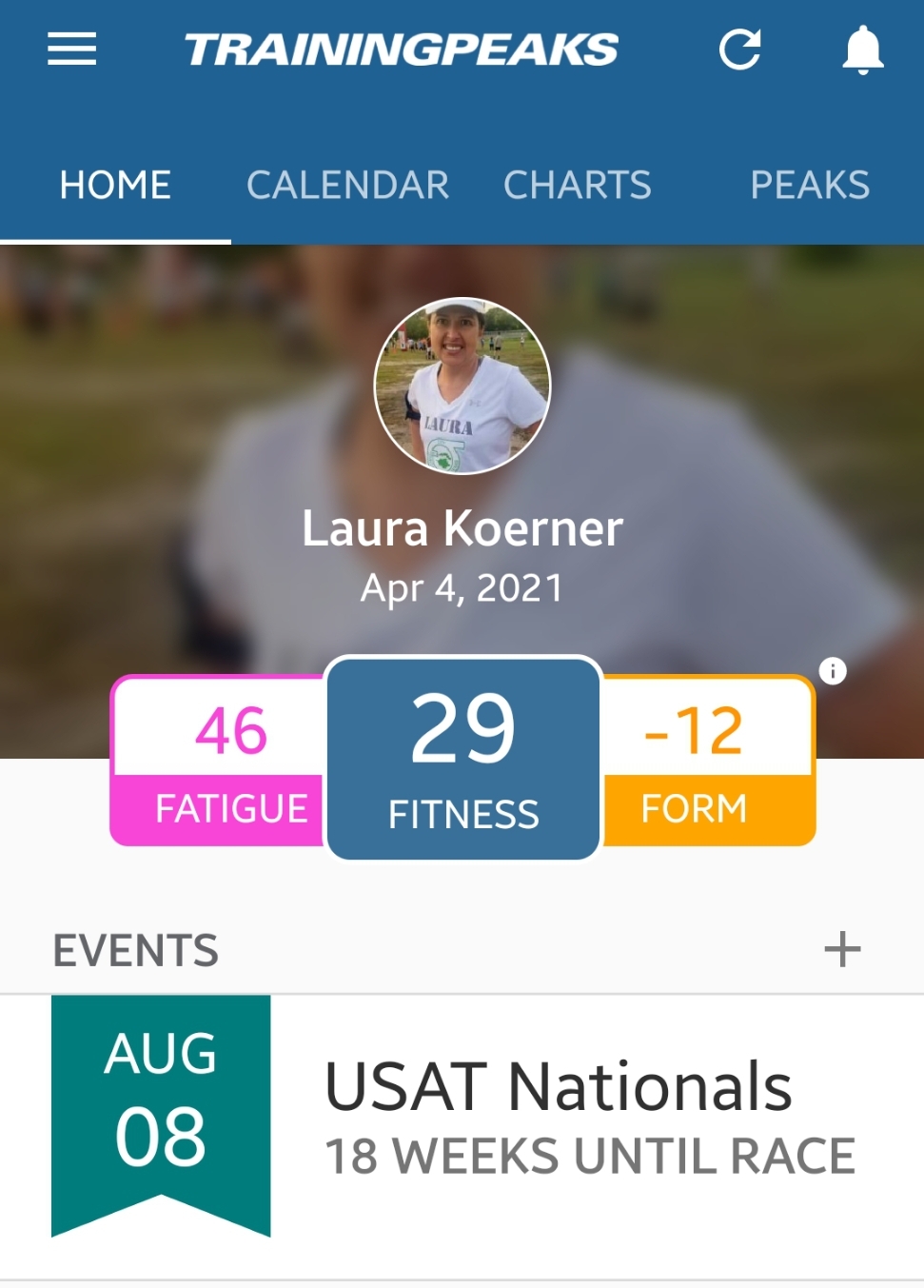
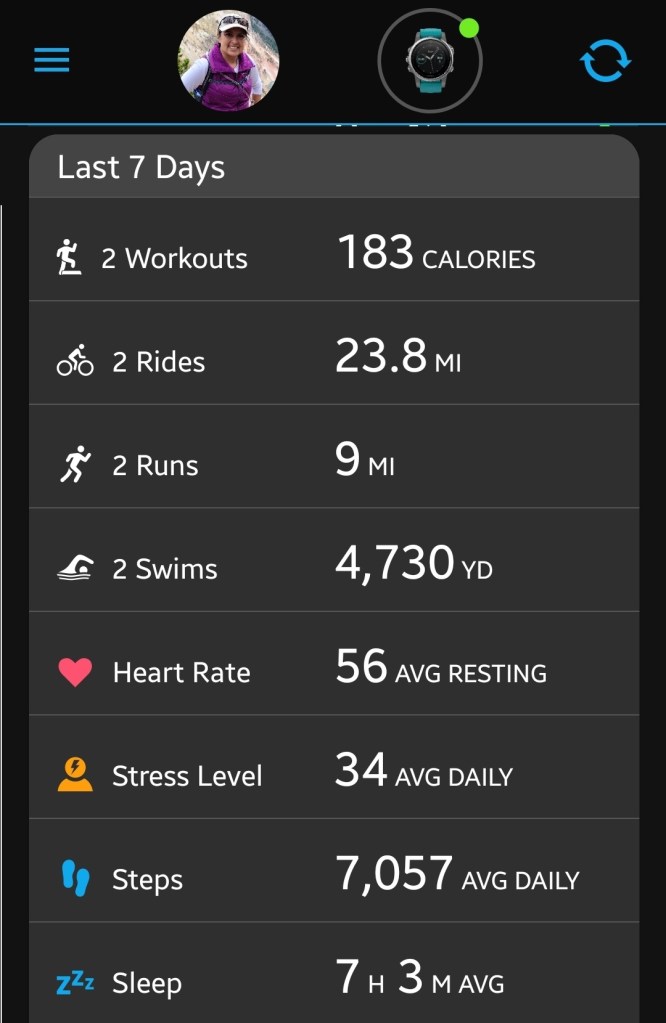
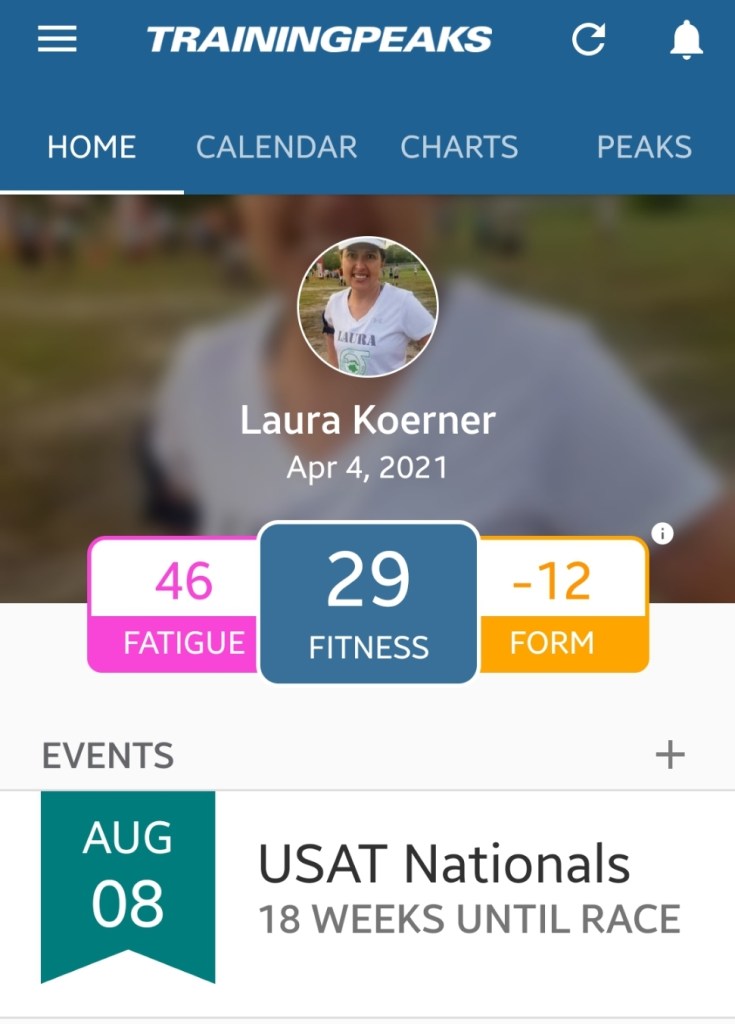
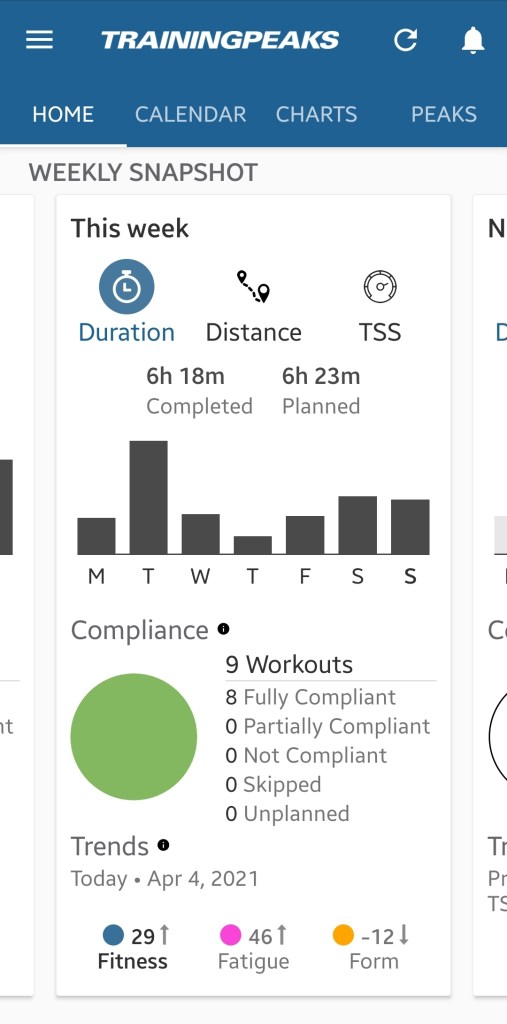
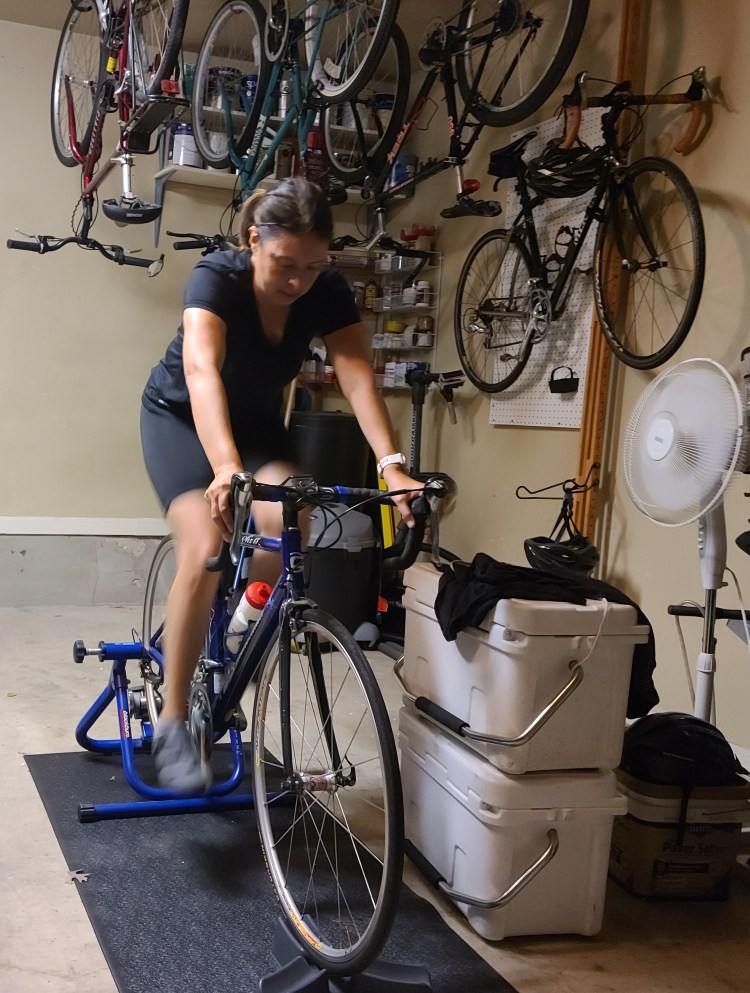
Week 1 is in the books and 18 more to go! Here is my week by the numbers: 8 workouts (2 of each sport, plus strength). 6+ hours. 378 TSS. One run on minimal sleep. One bike ride rained out, but moved to trainer. I increased my fitness level to 29, a +5 ramp up, which is well within the sustainable range. My risk & compliance friends will get a kick out of the fact that TrainingPeaks grades my compliance to my training plan each week.
It was actually a pretty good week. I got all my workouts done, when planned, and for most part at the correct intensities. Getting back into pool and on the bike went much smoother than I anticipated, but trying to hold back on my runs to stay in Zone 1 when I needed to ended up being very challenging.
I feel appropriately tired but not exhausted, but definitely need to work on getting more and better sleep, which is normally not a problem. Some of that is in my control and some not.
With 19 weeks to USAT Nationals, the excitement has now turned into anxiousness, bordering on fear that I will not be ready in time. I have a good level of everyday fitness and have been working out and running a few times a week, but certainly not to a level of multi-sport competitiveness. I haven’t trained in the pool or on my bike for months. This will require dusting off my coaching skills and selecting a training plan that best suits me. Luckily, planning is my profession.
Bare with me as I get into weeds of coaching and training specifics. You might find it interesting that preparing for a race of this caliber or any key priority race involves a lot more than just swimming, running, and biking a few times a week. There is just as much science as art, and some serious amount of math, equipment, and training sensors involved. All things an engineer, like me, enjoys.
I selected the 80/20 Triathlon: 2021 Edition Sprint Level 3 (Pace and Bike Heart Rate, 7 to 12 Hours per Week) Training Plan (with the Strength Training add-on) created by Coaches Matt Fitzgerald and David Warren. $55 This plan is hosted on the gold-standard application for endurance training, TrainingPeaks. I have always trained using TrainingPeaks, and Mike (hubby) and I used it when we coached athletes – before kids. The plan is described as “designed for serious triathletes who want to earn eternal glory by finishing their next sprint race as one of the top performers in their age group. Choose it only if you have a strong background in endurance racing and can already comfortably swim, bike, and run for an hour.” – 8020endurance.com I may have swung a little high by selecting the elite Level 3 version, but I guess racing at Nationals qualifies me for training like an elite athlete. I’m not sure about eternal glory though. The typical training week involves 3 Swim, 3 Bike, 3 Run, 1 day off, plus 2 Strength (add-on)
The plan met all my requirements:
19-week plan that will get me through race day
Designed for experienced triathletes – targeting performance on race day, rather than just completion.
The amount/time of training fits in my schedule (The high end of 7-12 hrs/week will be tough, but doable. Training time is the #1 reason I don’t race in longer triathlons anymore.)
Intensity targets that do not require power meters. (I have never seen the need to invest in expensive power meters for training. There are plenty of other expenses in triathlon, I didn’t need one more. Plus, I have had great success in training with pace and heart rate zones.)
Designed for TrainingPeaks
Structured workouts that sync/work with my Garmin devices
Plus, I agree with their training philosophy – 80% of training at a low intensity and only 20% of training at high intensity.
I loaded the plan into TrainingPeaks to confirm it was going to give the level of fitness that I wanted/needed and to make any tweaks based on my starting level of fitness. The first question is what level of fitness do I need? Followed quickly with, where am I now? I’ll tackle the second question first. That is where training with a Training Stress Score (TSS) comes in and all the performance metrics that TrainingPeaks calculates for you based on your workout data. “TSS is calculated by combining the duration of a workout with its Intensity Factor® (IF), how hard the athlete worked compared to his/her functional threshold, or the maximum intensity that can be sustained for approximately one hour.” – Trainingpeaks.com
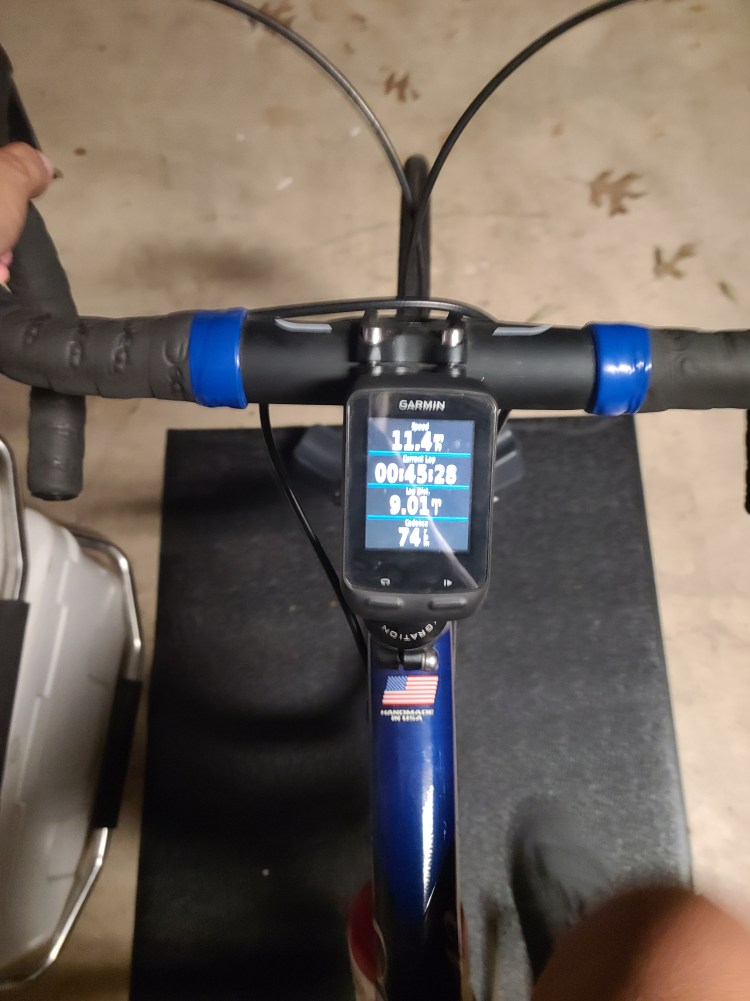
Intensity can be measured using many methods, as I mentioned earlier when I was talking about selecting my plan. The most accurate method is using power (which requires special power meter equipment), but pace and HR is the most common method. This means that most athletes need to invest in a good training watch and/or bike computer, like a Garmin, that will measure Heart Rate and/or pace throughout a workout. A good multi-sport watch, will measure it for all 3 sports, including swimming. I use a Garmin Fenix 5S watch and Garmin Edge 510 Bike Computer and since Garmin syncs with TrainingPeaks, once I finish my workout Training Peaks automatically calculates and determines the TSS for my workout. (BTW, there is much more on this topic, like determining and loading thresholds so the calculations are accurate, but I’m won’t get into that)
My fitness level (aka the measure of fitness I accumulated through my training), called Chronic Training Load (CTL), is then calculated based the six-week exponentially weighted average of my daily TSS. Luckily, TrainingPeaks does that for me. Since I’ve been using my Garmin watch for all my workouts and syncing it with TrainingPeaks, I know my current CTL, which is 24. (Fatigue and Form numbers are also helpful, but I won’t get into that either)
Side Note: This in no way measures how fast I am, just the level of training stress my body can maintain. Fitness level measurements will let me know if I’m training enough or too much for my race. The actual workout structure (i.e. 80/20) and how well I execute my workouts will determine how much my performance will increase.
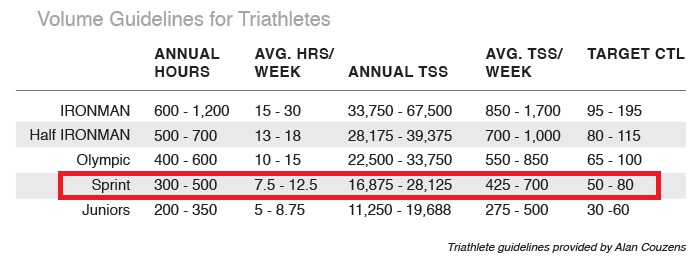
So, back to my question, confirming my training plan will be bring me to the right fitness level. I then looked up what my target CTL should be for my level of race, which based on the chart below appears to be 50-80.
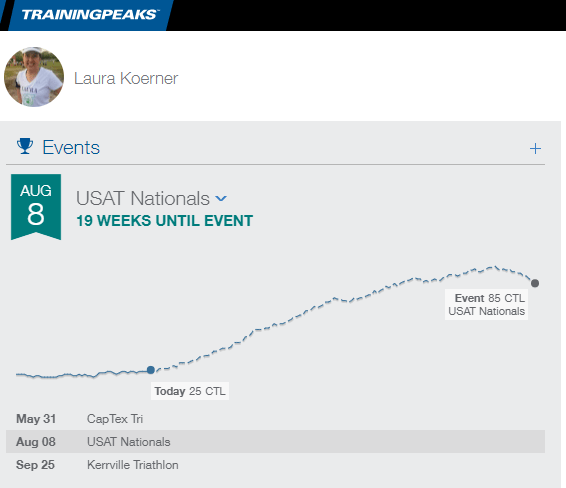
I then looked at my training plan that I loaded into TrainingPeaks, to see where I will end up on race day (see below). 85 is on the high end and the ramp up to get there also seems steep. But I also anticipate that I won’t be able to complete every workout based on busy work and family schedules. I already tweaked the first few weeks of the training plan to start off with just 2 bikes, 2 runs, 2 swims, and 2 strength, to ease my way into the plan, based on my current fitness level. This is the where the art comes in. I will have to pay close attention to my body and fatigue and adjust my training accordingly, knowing that the plan is already aggressive. Adjusting plans is hard to do properly, and in most cases, that is the benefit of hiring a coach, so they can adjust your plan wisely based on what they are observing in your training. Luckily Matt and David gave great guidance in their documentation on adjusting their plan and I have my and my husband’s training and experience as a coach to help.
Based on our busy family and work schedules, I will focus on training between 5am-7am and 5pm-7pm during the week and around family activities on the weekends. I prefer training in the morning, so most days will be morning workouts. So, now that I have a plan, I feel relieved and ready to execute. I also know I have to closely listen to my body to ensure I don’t get injured or overtrain and then adjust as necessary.
I received a surprising email this week. I qualified for USA Triathlon Age Group Nationals (Sprint Distance) in Milwaukee Aug 8th. I guess I need to start training. My evil plan is panning out… instead of getting better, I just get older and hang on.




 Don't Call It a Comeback